Rapid Organic Carbon Spiraling in a Headwater Stream Linked with Seasonal Streamflow, Biogeochemistry, and Canopy Phenology
Seven years of daily organic carbon spiraling in a well-studied headwater stream linked with riparian tree phenology and in-stream primary productivity.
April 10, 2026
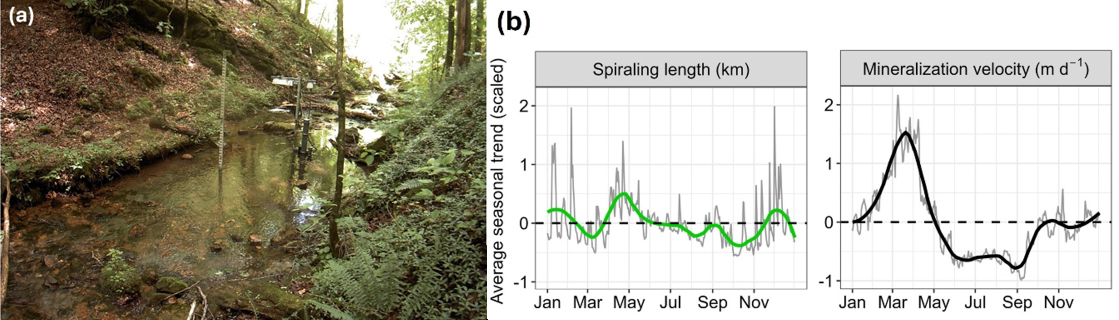
(a) Walker Branch during spring canopy cover, with (b) the average seasonal patterns in carbon spiraling metrics over 7 years.
[(a) Courtesy PhenoCam Network. (b) Adapted from Pilla, R. M., et al. 2026. “Rapid Organic Carbon Spiraling in a Headwater Stream Linked with Streamflow, Biogeochemistry, and Canopy Phenology,” Freshwater Science 45(2), 147–61. DOI:10.1086/740164.]
The Science
Headwater streams are abundant worldwide and important processors and transporters of organic carbon. Organic carbon spiraling can be used to understand and compare the retention and mineralization of organic carbon in streams to understand carbon use efficiency versus downstream transport. In a small headwater stream (Walker Branch in Tennessee), organic carbon spiraling length was one order of magnitude shorter compared to other small streams. Organic carbon spiraling was faster during the more biologically active periods of spring and autumn and slower in summer and winter when carbon retention was lower but downstream transport higher. Light, primary production, and nitrate were the strongest drivers of patterns in organic carbon spiraling in Walker Branch, where short- or long-term changes in these variables could influence carbon processing and downstream transport.
The Impact
This study highlights the rapid organic carbon processing in Walker Branch relative to other headwater streams. Further, long-term trends toward earlier and longer canopy cover resulting in reduced light and primary production may slow organic carbon spiraling, reducing localized in-stream processing and potentially shunting more downstream. However, effects of long-term reductions of nitrate at Walker Branch suggest opposing effects, which would result in faster organic carbon spiraling and greater in-stream retention. This detailed time series analysis enhances understanding of current and future responses of carbon processing in head-water streams as well as implications for downstream carbon dynamics.
Summary
Researchers used 7 years of daily data in a small headwater stream to assess seasonal and interannual patterns in organic carbon spiraling and then linked these data with potential driver variables. Organic carbon spiraling is a useful way to assess carbon retention, processing, and transport in streams, though it has received notably less attention compared to nutrient spiraling. Further, analyses of seasonal and interannual variability in organic carbon spiraling are currently limited, leaving knowledge gaps in the driving mechanisms of and potential changes to within-stream carbon spiraling and downstream carbon transport. Walker Branch had very rapid organic carbon spiraling rates compared to other small head-water streams and was most rapid in spring and autumn during biologically active periods in the ecosystem. Carbon spiraling was primarily driven by seasonal variability in light, primary production, and nitrate, but trends in these drivers suggest opposing effects on organic carbon spiraling at Walker Branch. While these analyses and mechanisms give important insights into organic carbon spiraling at highly temporally resolved scales, future studies on seasonal variability in organic carbon spiraling should build on this work across a variety of stream types to understand their roles in global organic carbon processing.
References
Pilla, R. M., N. A. Griffiths, and B. J. Roberts. "Rapid Organic Carbon Spiraling in a Headwater Stream Linked with Streamflow, Biogeochemistry, and Canopy Phenology." Freshwater Science 45 (2), 147–61 (2026). https://doi.org/10.1086/740164.