Accounting for the Hyporheic Zone in Stream Metabolism Models
A multiscale reactive transport model provides new insights into stream oxygen dynamics.
January 08, 2026
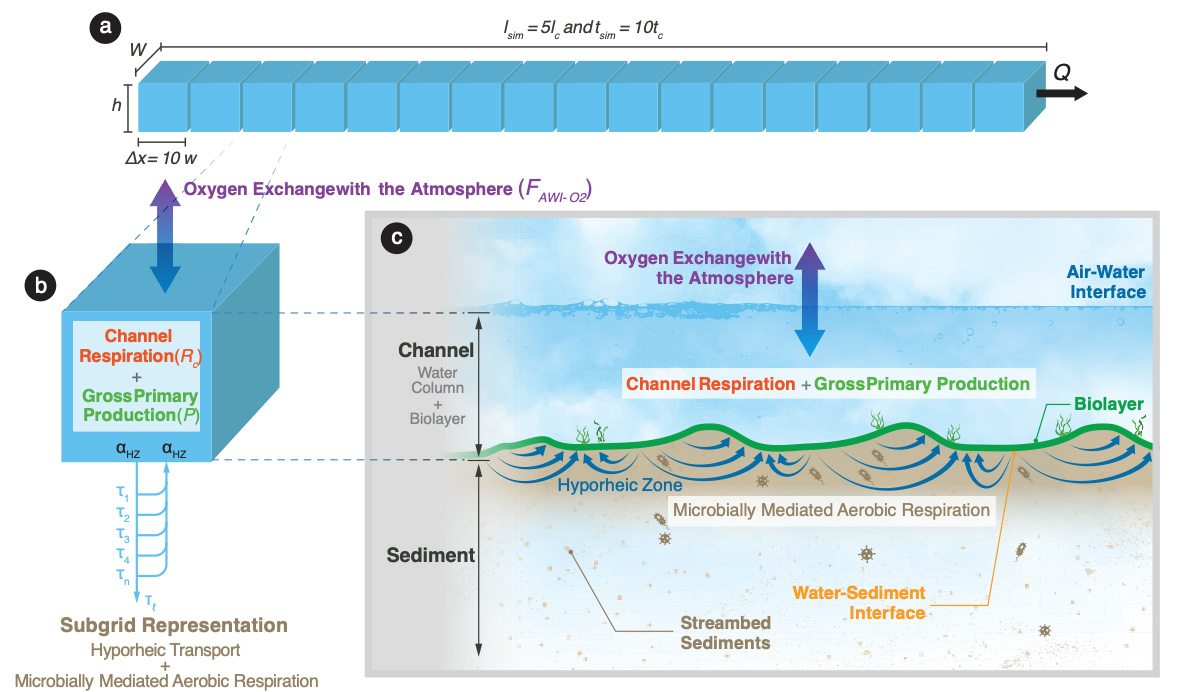
Multiscale model for oxygen dynamics in stream corridors. Transport in the stream channel (a) is coupled to subgrid models for hyporheic exchange and reactive transport in the adjacent sediments (b) to mimic the natural stream metabolism processes (c).
[Reprinted under a Creative Commons License (CC BY 4.0) from Gomez-Velez, J. D., et al. 2026. “Hyporheic-Zone Processes and Stream Oxygen Dynamics: Insights from a Multiscale Reactive Transport Model,” Water Resources Research 62(1), e2025WR040208. DOI:10.1029/2025WR040208.]
The Science
Stream metabolism, the set of processes that transform carbon and produce and consume oxygen in streams, is an important indicator of stream health. Researchers developed a new model to represent stream oxygen dynamics that explicitly accounts for in-channel processes and oxygen consumption by microbial respiration in the hyporheic zone, the water-saturated sediments near the channel. Researchers found mass exchange and hyporheic zone transport significantly alter oxygen dynamics, even for sediments that do not support respiration. Existing models that combine the hyporheic zone with the stream channel can result in significant biases in estimated metabolism rates.
The Impact
Rates of oxygen production by photosynthesis and consumption by respiration in streams are often estimated from changes in oxygen concentrations using the single-station metabolism (SSM) model. The SSM model makes a critical assumption that all processes that consume oxygen can be lumped into a single ecosystem respiration rate. Researchers found the SSM model can produce biased metabolism assessments even when oxygen dynamics are well represented. They propose a new model that better accounts for the metabolically active hyporheic zone and provides a more robust method for assessing stream metabolism from dissolved oxygen dynamics.
Summary
Aquatic ecosystem metabolism encapsulates the daily fixation (gross primary production) and mineralization (ecosystem respiration) of organic carbon, producing and consuming oxygen in the process. In streams and rivers, those metabolic fluxes are commonly estimated from observed oxygen concentrations by inverse modeling using a model that describes how oxygen concentrations in the water column vary throughout a day. The most common model for those assessments, the SSM model, implicitly assumes that all processes consuming oxygen can be lumped into a bulk estimate of respiration. Researchers configured a recently developed multiscale model for transport and reactions in stream corridors to represent stream metabolism and used it to explore consequences of simplifying assumptions in the SSM model.
This multiscale model explicitly represents mass exchange limitations between the stream channel and the hyporheic zone as well as transport and respiration along multiple pathways in the hyporheic zone. Numerical experiments with the multiscale model provide insights into the effects of hyporheic processes on oxygen dynamics. While the SSM model performed well in many situations, researchers identified conditions where significant bias is produced by neglecting hyporheic exchange, even when oxygen data are well fitted. These situations pose a major challenge in the interpretation of metabolism assessment using the SSM model.
References
Gomez-Velez, J. D., S. S. Rathore, M. J. Cohen, and S. L. Painter. "Hyporheic-Zone Processes and Stream Oxygen Dynamics: Insights from a Multiscale Reactive Transport Model." Water Resources Research 62 (1), e2025WR040208 (2026). https://doi.org/10.1029/2025WR040208.